 Add to Chrome
 Add to Firefox
 Add to Edge
Q-GeoMem: Question-Guided Geometric Memory for Video Spatial Reasoning
May 26, 2026
Video spatial reasoning requires accumulating viewpoint-dependent evidence over time while retaining information useful to the question being asked. Existing spatial video-language models improve geometric perception and long-range context modeling, but often treat memory as a generic temporal cache, which can introduce redundant or irrelevant geometry and weaken long-horizon reasoning. We propose \textbf{\ours}, a question-guided geometric memory framework for video spatial reasoning. \ours injects camera-conditioned geometry into visual tokens and maintains two complementary memories: a Fine-Grained Context Bank for recent dense features and camera states, and a Semantic-Geometric Evidence Bank for compact long-range evidence. Each candidate frame is scored by the product of Q-Former-based question relevance and novelty with respect to the retained bank; this score is stored and reused during reading, while a capacity-based replacement rule keeps the bank compact. During reasoning, both memories are read before update and adaptively fused with the current frame representation. Experiments on VSI-Bench and VSTI-Bench show that \ours achieves state-of-the-art performance among evaluated spatial reasoning models, validating the effectiveness of question-guided geometric memory. Ablations further verify the contribution of the proposed evidence scoring mechanism.

VGGT-Edit: Feed-forward Native 3D Scene Editing with Residual Field Prediction
May 14, 2026High-quality 3D scene reconstruction has recently advanced toward generalizable feed-forward architectures, enabling the generation of complex environments in a single forward pass. However, despite their strong performance in static scene perception, these models remain limited in responding to dynamic human instructions, which restricts their use in interactive applications. Existing editing methods typically rely on a 2D-lifting strategy, where individual views are edited independently and then lifted back into 3D space. This indirect pipeline often leads to blurry textures and inconsistent geometry, as 2D editors lack the spatial awareness required to preserve structure across viewpoints. To address these limitations, we propose VGGT-Edit, a feed-forward framework for text-conditioned native 3D scene editing. VGGT-Edit introduces depth-synchronized text injection to align semantic guidance with the backbone's spatial poses, ensuring stable instruction grounding. This semantic signal is then processed by a residual transformation head, which directly predicts 3D geometric displacements to deform the scene while preserving background stability. To ensure high-fidelity results, we supervise the framework with a multi-term objective function that enforces geometric accuracy and cross-view consistency. We also construct the DeltaScene Dataset, a large-scale dataset generated through an automated pipeline with 3D agreement filtering to ensure ground-truth quality. Experiments show that VGGT-Edit substantially outperforms 2D-lifting baselines, producing sharper object details, stronger multi-view consistency, and near-instant inference speed.
Openpi Comet: Competition Solution For 2025 BEHAVIOR Challenge
Dec 12, 2025The 2025 BEHAVIOR Challenge is designed to rigorously track progress toward solving long-horizon tasks by physical agents in simulated environments. BEHAVIOR-1K focuses on everyday household tasks that people most want robots to assist with and these tasks introduce long-horizon mobile manipulation challenges in realistic settings, bridging the gap between current research and real-world, human-centric applications. This report presents our solution to the 2025 BEHAVIOR Challenge in a very close 2nd place and substantially outperforms the rest of the submissions. Building on $π_{0.5}$, we focus on systematically building our solution by studying the effects of training techniques and data. Through careful ablations, we show the scaling power in pre-training and post-training phases for competitive performance. We summarize our practical lessons and design recommendations that we hope will provide actionable insights for the broader embodied AI community when adapting powerful foundation models to complex embodied scenarios.
Are We Ready for RL in Text-to-3D Generation? A Progressive Investigation
Dec 11, 2025Reinforcement learning (RL), earlier proven to be effective in large language and multi-modal models, has been successfully extended to enhance 2D image generation recently. However, applying RL to 3D generation remains largely unexplored due to the higher spatial complexity of 3D objects, which require globally consistent geometry and fine-grained local textures. This makes 3D generation significantly sensitive to reward designs and RL algorithms. To address these challenges, we conduct the first systematic study of RL for text-to-3D autoregressive generation across several dimensions. (1) Reward designs: We evaluate reward dimensions and model choices, showing that alignment with human preference is crucial, and that general multi-modal models provide robust signal for 3D attributes. (2) RL algorithms: We study GRPO variants, highlighting the effectiveness of token-level optimization, and further investigate the scaling of training data and iterations. (3) Text-to-3D Benchmarks: Since existing benchmarks fail to measure implicit reasoning abilities in 3D generation models, we introduce MME-3DR. (4) Advanced RL paradigms: Motivated by the natural hierarchy of 3D generation, we propose Hi-GRPO, which optimizes the global-to-local hierarchical 3D generation through dedicated reward ensembles. Based on these insights, we develop AR3D-R1, the first RL-enhanced text-to-3D model, expert from coarse shape to texture refinement. We hope this study provides insights into RL-driven reasoning for 3D generation. Code is released at https://github.com/Ivan-Tang-3D/3DGen-R1.
F1: A Vision-Language-Action Model Bridging Understanding and Generation to Actions
Sep 09, 2025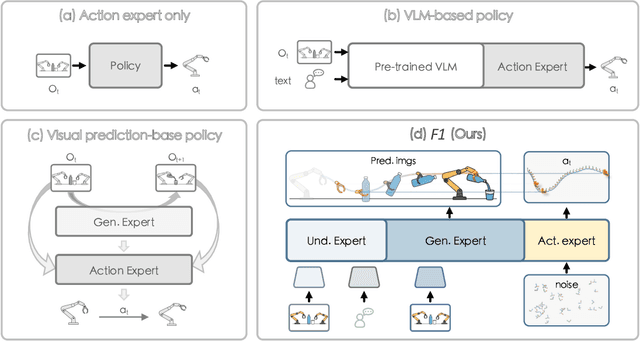

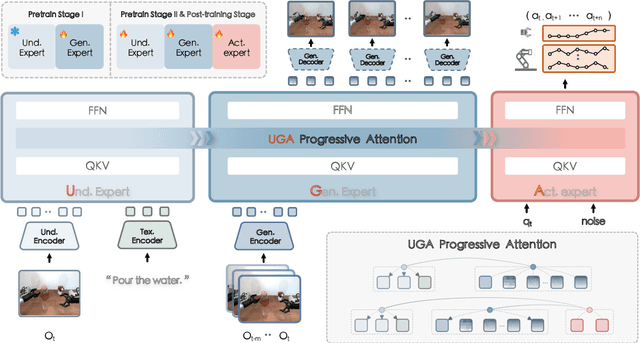
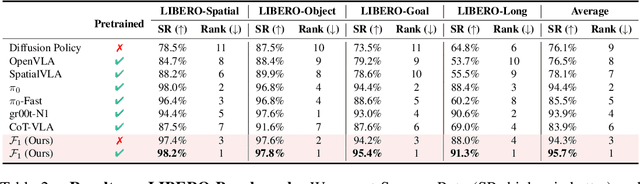
Executing language-conditioned tasks in dynamic visual environments remains a central challenge in embodied AI. Existing Vision-Language-Action (VLA) models predominantly adopt reactive state-to-action mappings, often leading to short-sighted behaviors and poor robustness in dynamic scenes. In this paper, we introduce F1, a pretrained VLA framework which integrates the visual foresight generation into decision-making pipeline. F1 adopts a Mixture-of-Transformer architecture with dedicated modules for perception, foresight generation, and control, thereby bridging understanding, generation, and actions. At its core, F1 employs a next-scale prediction mechanism to synthesize goal-conditioned visual foresight as explicit planning targets. By forecasting plausible future visual states, F1 reformulates action generation as a foresight-guided inverse dynamics problem, enabling actions that implicitly achieve visual goals. To endow F1 with robust and generalizable capabilities, we propose a three-stage training recipe on an extensive dataset comprising over 330k trajectories across 136 diverse tasks. This training scheme enhances modular reasoning and equips the model with transferable visual foresight, which is critical for complex and dynamic environments. Extensive evaluations on real-world tasks and simulation benchmarks demonstrate F1 consistently outperforms existing approaches, achieving substantial gains in both task success rate and generalization ability.
EmbodiedOneVision: Interleaved Vision-Text-Action Pretraining for General Robot Control
Aug 28, 2025The human ability to seamlessly perform multimodal reasoning and physical interaction in the open world is a core goal for general-purpose embodied intelligent systems. Recent vision-language-action (VLA) models, which are co-trained on large-scale robot and visual-text data, have demonstrated notable progress in general robot control. However, they still fail to achieve human-level flexibility in interleaved reasoning and interaction. In this work, introduce EO-Robotics, consists of EO-1 model and EO-Data1.5M dataset. EO-1 is a unified embodied foundation model that achieves superior performance in multimodal embodied reasoning and robot control through interleaved vision-text-action pre-training. The development of EO-1 is based on two key pillars: (i) a unified architecture that processes multimodal inputs indiscriminately (image, text, video, and action), and (ii) a massive, high-quality multimodal embodied reasoning dataset, EO-Data1.5M, which contains over 1.5 million samples with emphasis on interleaved vision-text-action comprehension. EO-1 is trained through synergies between auto-regressive decoding and flow matching denoising on EO-Data1.5M, enabling seamless robot action generation and multimodal embodied reasoning. Extensive experiments demonstrate the effectiveness of interleaved vision-text-action learning for open-world understanding and generalization, validated through a variety of long-horizon, dexterous manipulation tasks across multiple embodiments. This paper details the architecture of EO-1, the data construction strategy of EO-Data1.5M, and the training methodology, offering valuable insights for developing advanced embodied foundation models.
Hume: Introducing System-2 Thinking in Visual-Language-Action Model
May 29, 2025
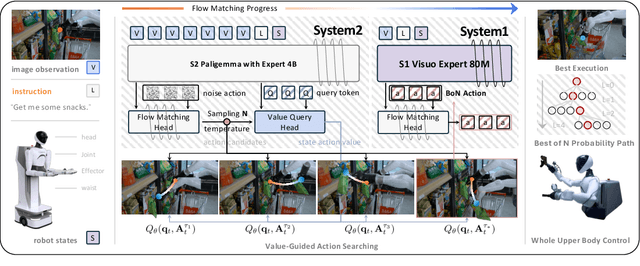
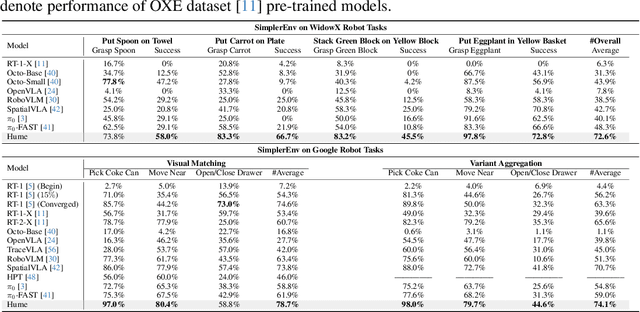
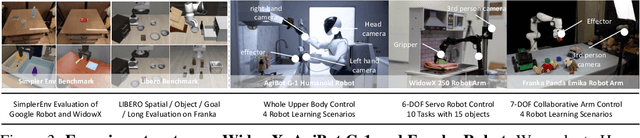
Humans practice slow thinking before performing actual actions when handling complex tasks in the physical world. This thinking paradigm, recently, has achieved remarkable advancement in boosting Large Language Models (LLMs) to solve complex tasks in digital domains. However, the potential of slow thinking remains largely unexplored for robotic foundation models interacting with the physical world. In this work, we propose Hume: a dual-system Vision-Language-Action (VLA) model with value-guided System-2 thinking and cascaded action denoising, exploring human-like thinking capabilities of Vision-Language-Action models for dexterous robot control. System 2 of Hume implements value-Guided thinking by extending a Vision-Language-Action Model backbone with a novel value-query head to estimate the state-action value of predicted actions. The value-guided thinking is conducted by repeat sampling multiple action candidates and selecting one according to state-action value. System 1 of Hume is a lightweight reactive visuomotor policy that takes System 2 selected action and performs cascaded action denoising for dexterous robot control. At deployment time, System 2 performs value-guided thinking at a low frequency while System 1 asynchronously receives the System 2 selected action candidate and predicts fluid actions in real time. We show that Hume outperforms the existing state-of-the-art Vision-Language-Action models across multiple simulation benchmark and real-robot deployments.
Revisiting Multi-Agent World Modeling from a Diffusion-Inspired Perspective
May 27, 2025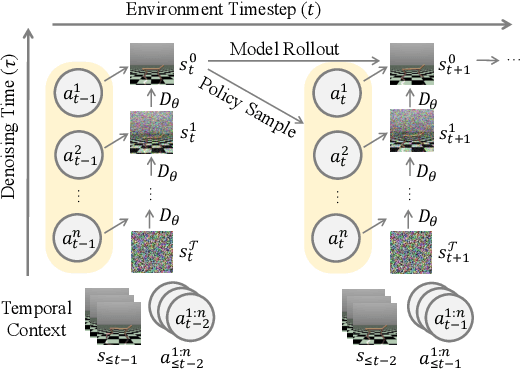
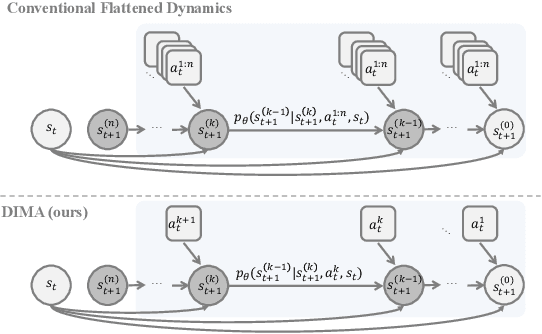
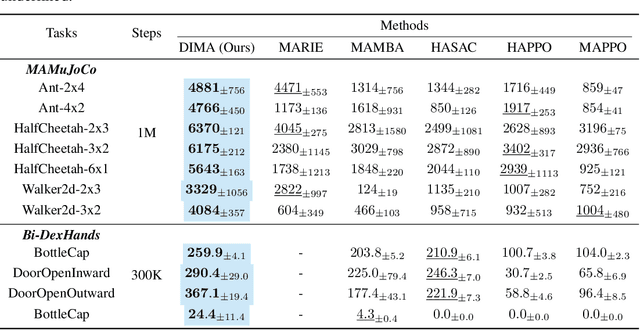
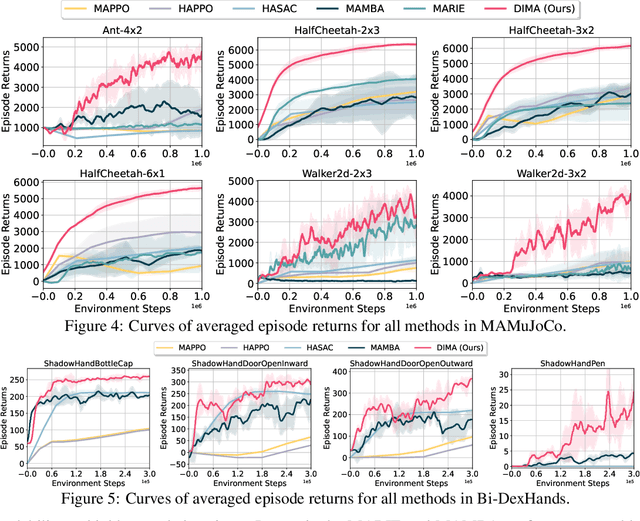
World models have recently attracted growing interest in Multi-Agent Reinforcement Learning (MARL) due to their ability to improve sample efficiency for policy learning. However, accurately modeling environments in MARL is challenging due to the exponentially large joint action space and highly uncertain dynamics inherent in multi-agent systems. To address this, we reduce modeling complexity by shifting from jointly modeling the entire state-action transition dynamics to focusing on the state space alone at each timestep through sequential agent modeling. Specifically, our approach enables the model to progressively resolve uncertainty while capturing the structured dependencies among agents, providing a more accurate representation of how agents influence the state. Interestingly, this sequential revelation of agents' actions in a multi-agent system aligns with the reverse process in diffusion models--a class of powerful generative models known for their expressiveness and training stability compared to autoregressive or latent variable models. Leveraging this insight, we develop a flexible and robust world model for MARL using diffusion models. Our method, Diffusion-Inspired Multi-Agent world model (DIMA), achieves state-of-the-art performance across multiple multi-agent control benchmarks, significantly outperforming prior world models in terms of final return and sample efficiency, including MAMuJoCo and Bi-DexHands. DIMA establishes a new paradigm for constructing multi-agent world models, advancing the frontier of MARL research.
Think Small, Act Big: Primitive Prompt Learning for Lifelong Robot Manipulation
Apr 01, 2025Building a lifelong robot that can effectively leverage prior knowledge for continuous skill acquisition remains significantly challenging. Despite the success of experience replay and parameter-efficient methods in alleviating catastrophic forgetting problem, naively applying these methods causes a failure to leverage the shared primitives between skills. To tackle these issues, we propose Primitive Prompt Learning (PPL), to achieve lifelong robot manipulation via reusable and extensible primitives. Within our two stage learning scheme, we first learn a set of primitive prompts to represent shared primitives through multi-skills pre-training stage, where motion-aware prompts are learned to capture semantic and motion shared primitives across different skills. Secondly, when acquiring new skills in lifelong span, new prompts are appended and optimized with frozen pretrained prompts, boosting the learning via knowledge transfer from old skills to new ones. For evaluation, we construct a large-scale skill dataset and conduct extensive experiments in both simulation and real-world tasks, demonstrating PPL's superior performance over state-of-the-art methods.
Uni$\textbf{F}^2$ace: Fine-grained Face Understanding and Generation with Unified Multimodal Models
Mar 11, 2025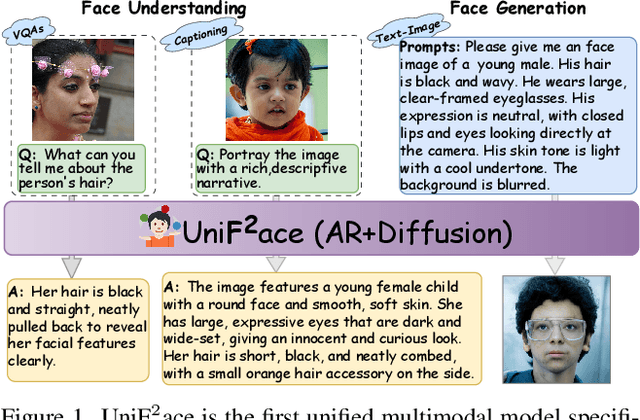
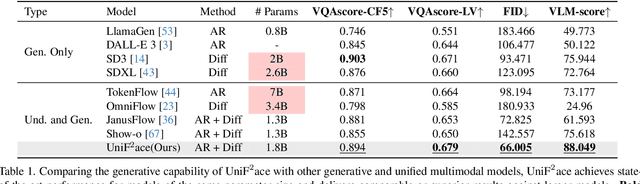

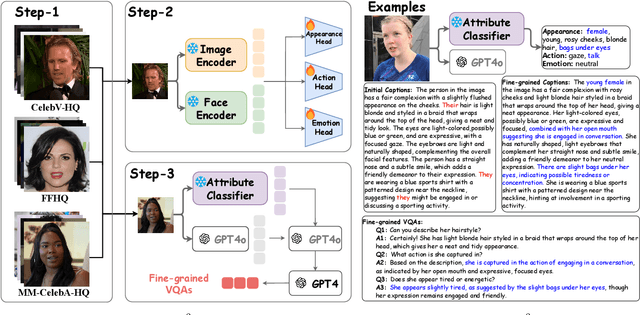
Unified multimodal models (UMMs) have emerged as a powerful paradigm in foundational computer vision research, demonstrating significant potential in both image understanding and generation. However, existing research in the face domain primarily focuses on $\textbf{coarse}$ facial attribute understanding, with limited capacity to handle $\textbf{fine-grained}$ facial attributes and without addressing generation capabilities. To overcome these limitations, we propose Uni$\textbf{F}^2$ace, the first UMM tailored specifically for fine-grained face understanding and generation. In general, we train Uni$\textbf{F}^2$ace on a self-constructed, specialized dataset utilizing two mutually beneficial diffusion techniques and a two-level mixture-of-experts architecture. Specifically, we first build a large-scale facial dataset, Uni$\textbf{F}^2$ace-130K, which contains 130K image-text pairs with one million question-answering pairs that span a wide range of facial attributes. Second, we establish a theoretical connection between discrete diffusion score matching and masked generative models, optimizing both evidence lower bounds simultaneously, which significantly improves the model's ability to synthesize facial details. Finally, we introduce both token-level and sequence-level mixture-of-experts, enabling efficient fine-grained representation learning for both understanding and generation tasks. Extensive experiments on Uni$\textbf{F}^2$ace-130K demonstrate that Uni$\textbf{F}^2$ace outperforms existing UMMs and generative models, achieving superior performance across both understanding and generation tasks.